
Decisions about children are often made about them, not with them. It is important that children can participate and are included. In the school context, it often happens that teachers and parents discuss the learning of children or make decisions about things that concern children (anything from organising a school trip to changing the time school starts) without children being present. The United Nations Convention on the Rights of the Child (UNCRC) defines participation and the right to express their opinion as a basic child right. Parents as the main guardians of their children’s rights play an important role as the UNCRC ties certain rights to the evolving capacities of the individual child that is the parents’ basic duty to judge. However, teachers as professionals can help parents in this. Adults often misjudge the capacity of children to make decisions. Children are more capable than most think. Even 2-year-olds can make meaningful decisions with the right facilitations. Thus, child participation is an imperative in school as children of compulsory schooling age are capable of making decisions.
Child Participation means that children can discuss and co-decide on ALL matters that affect them, like family, school, community matters, even government or legal policies. It means that their voices are being heard.
Child participation is also important from a pedagogical perspective as it is positive for the development of children and youth. School should be a safe training ground for active citizenship with relatively low-stakes decisions. It increases self-esteem and self-belief. Taking the consequences of bad decisions also builds resilience.
Child participation has a positive impact on later community engagement and active citizenship. If children can co-decide on matters that affect them directly they will have a need for it at later ages, too.
At the same time, children have the basic right to be heard and they have the right to access information provided by the UNCRC.
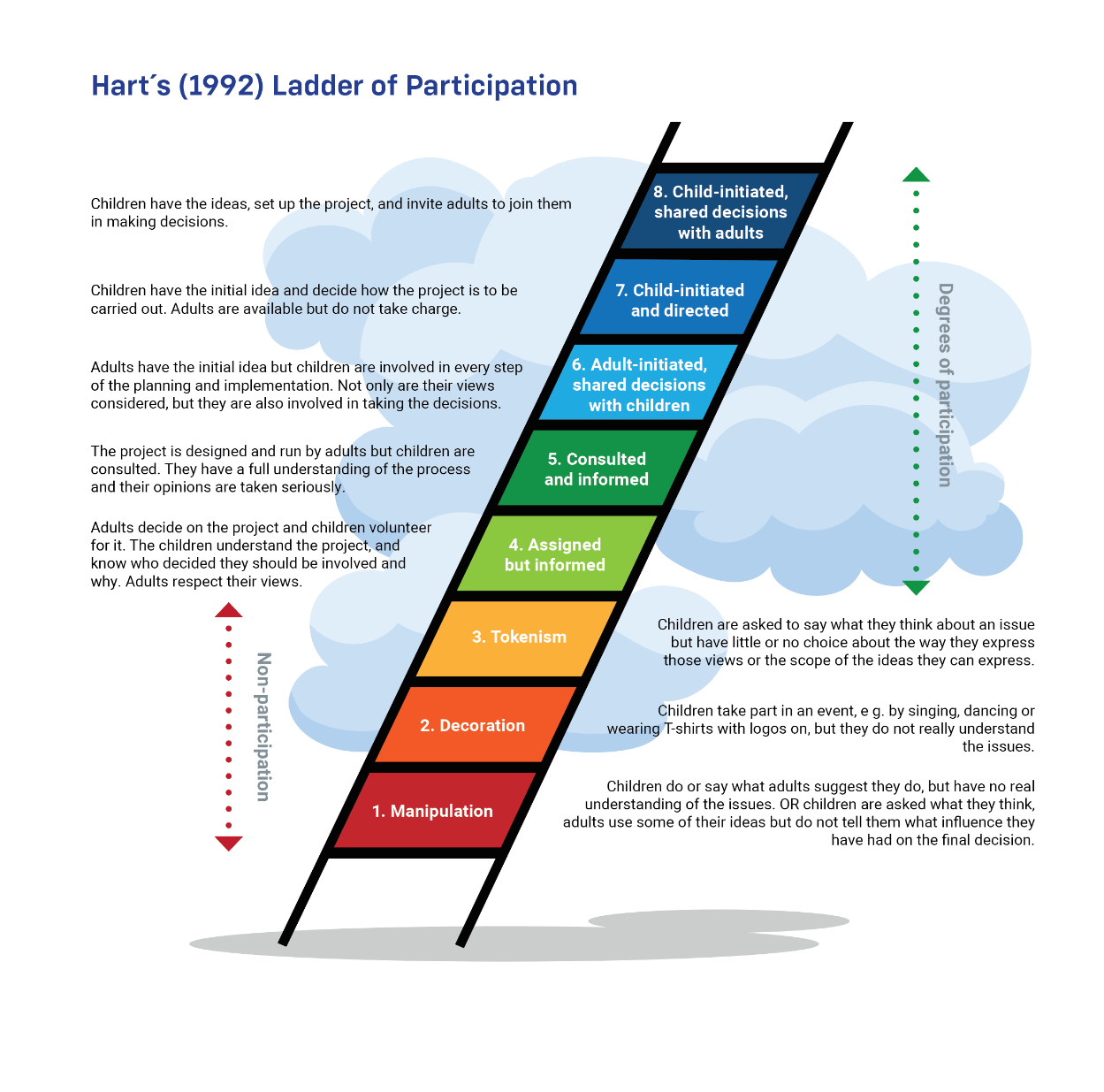
Based on Arnstein’s Ladder of Participation, Hart has developed the Ladder of Child Participation that can guide your activities in the field.
Essay:
In your learning journal, share what decisions you engage your students in and what other decisions you think you should engage them in.